-
By pgigrwpakistan
-
February 7, 2024
- 0 Comment
Mastering Gel Coat Application: How to Eliminate Blistering, Pinholes, and Fiber Print-Through
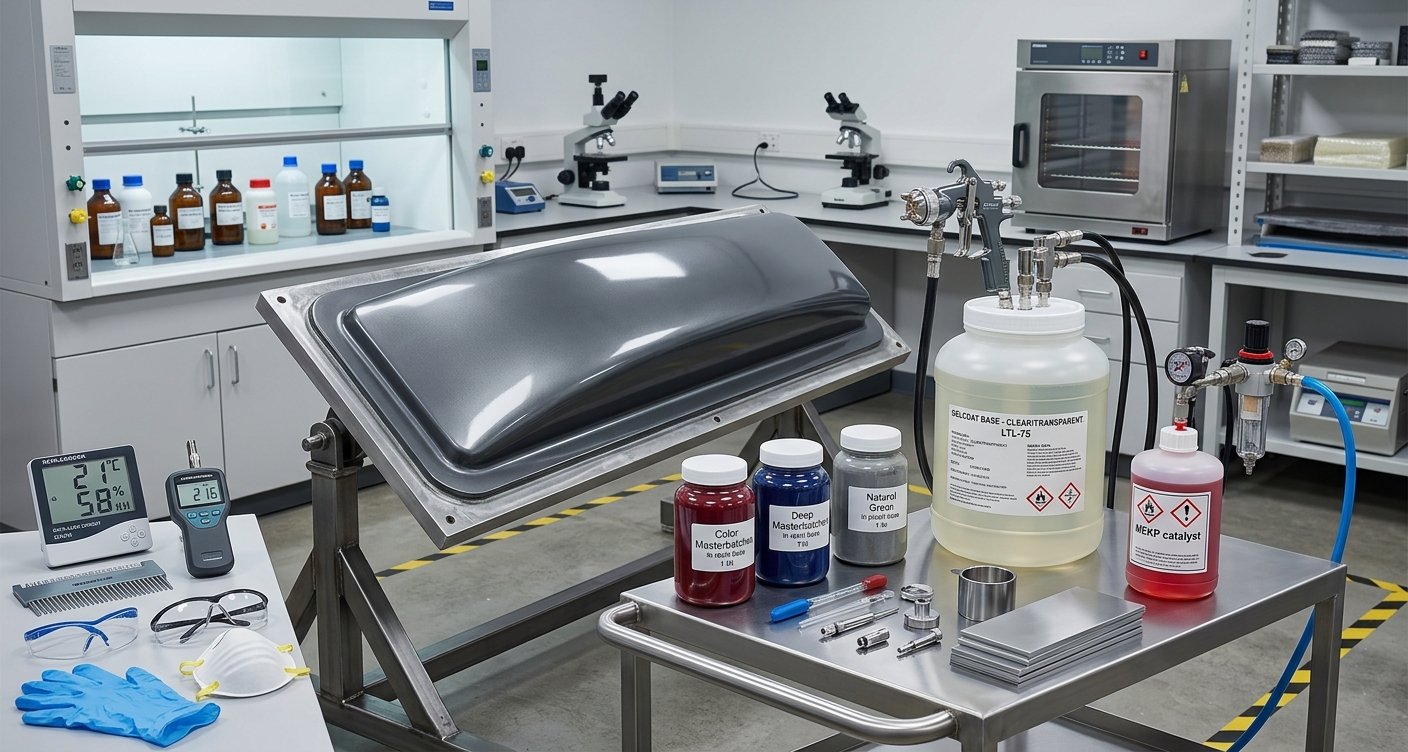
Gel coat serves as the critical first line of defense for composite structures—delivering a smooth, weather-resistant aesthetic while shielding underlying reinforcement fibers from UV degradation and water ingress. Achieving a defect-free surface, however, requires precise application mechanics and strict environmental control during production.
Common Surface Defects & Technical Root Causes
Minor deviations during spray-up or hand application can compromise the cosmetic finish and long-term durability of the laminate:
Fiber Print-Through: Occurs when the resin exotherm shrinks excessively during skin coat curing, pulling the texture of glass fibers through to the gel coat surface.
Pinholes & Air Entrapment: Caused by high atomization pressure during spraying, improper fluid tip sizing, or applying coats too thick in a single pass.
Blistering (Osmotic Action): Triggered by under-cured gel coats or moisture contamination on the mold surface prior to spraying.
Alligatoring: Results when the gel coat is top-coated with structural resin before it has reached an adequate state of cure.
Key Technical Parameters for Application
| Parameter | Standard Target | Consequences of Deviation |
| Wet Film Thickness | 18 to 22 mils ($0.45 – 0.55 \text{ mm}$) | $<15\text{ mils}$: Cure inhibition, alligatoring $>25\text{ mils}$: Sagging, thermal cracking |
| Spray Atomization Pressure | 40 to 60 psi | Too high introduces micro-air bubbles; too low creates uneven pattern droplets. |
| MEKP Catalyst Level | 1.5% to 2.0% by weight | $<1.2\%$: Sticky surface, porosity $>2.5\%$: Premature gelation, high shrinkage |
| Mold Surface Temp | 18°C to 28°C (65°F – 82°F) | Cold molds delay curing; hot molds accelerate exotherm and cause pre-release. |
Best Practices for Defect-Free Surface Finishes
Apply in Multiple Light Passes: Build wet film thickness systematically using a 50% overlap pattern rather than attempting a heavy single application.
Gauge Thickness Regularly: Use a wet-film comb gauge across multiple points of the mold face during application to maintain a consistent 20-mil thickness.
Use a Zero-Glass Skin Coat: Apply a barrier layer using a high-density resin and micro-fine surface mat before adding heavy woven roving or chopped strands.
Enforce Environmental Controls: Keep relative humidity under 70% and maintain a clean, dust-free spray booth to eliminate particulate contamination.
Controlling film thickness, atomization parameters, and mold temperatures ensures your gel coats form a resilient, defect-free barrier that elevates the visual quality and service life of every composite product.