-
By pgigrwpakistan
-
February 7, 2024
- 0 Comment
How Fire-Retardant Resin Systems Are Revolutionizing Composite Construction
Safety and flame compliance are non-negotiable in modern composite manufacturing. From public transit interiors to industrial grating and structural panels, Fiber-Reinforced Polymer (FRP) materials must meet stringent fire, smoke, and toxicity (FST) standards. Fire-retardant (FR) resin systems allow engineers to leverage the weight-saving benefits of composites without sacrificing fire resistance.
Key Mechanisms of Fire-Retardant Resins
Standard unsaturated polyester resins (UPR) and epoxies are organic polymers that burn readily under high heat. Fire-retardant resins incorporate specific chemistry to inhibit flame propagation:
Halogenated Additives: Chlorine or bromine compounds interrupt the chemical chain reaction in the gas phase during combustion, smothering active radicals.
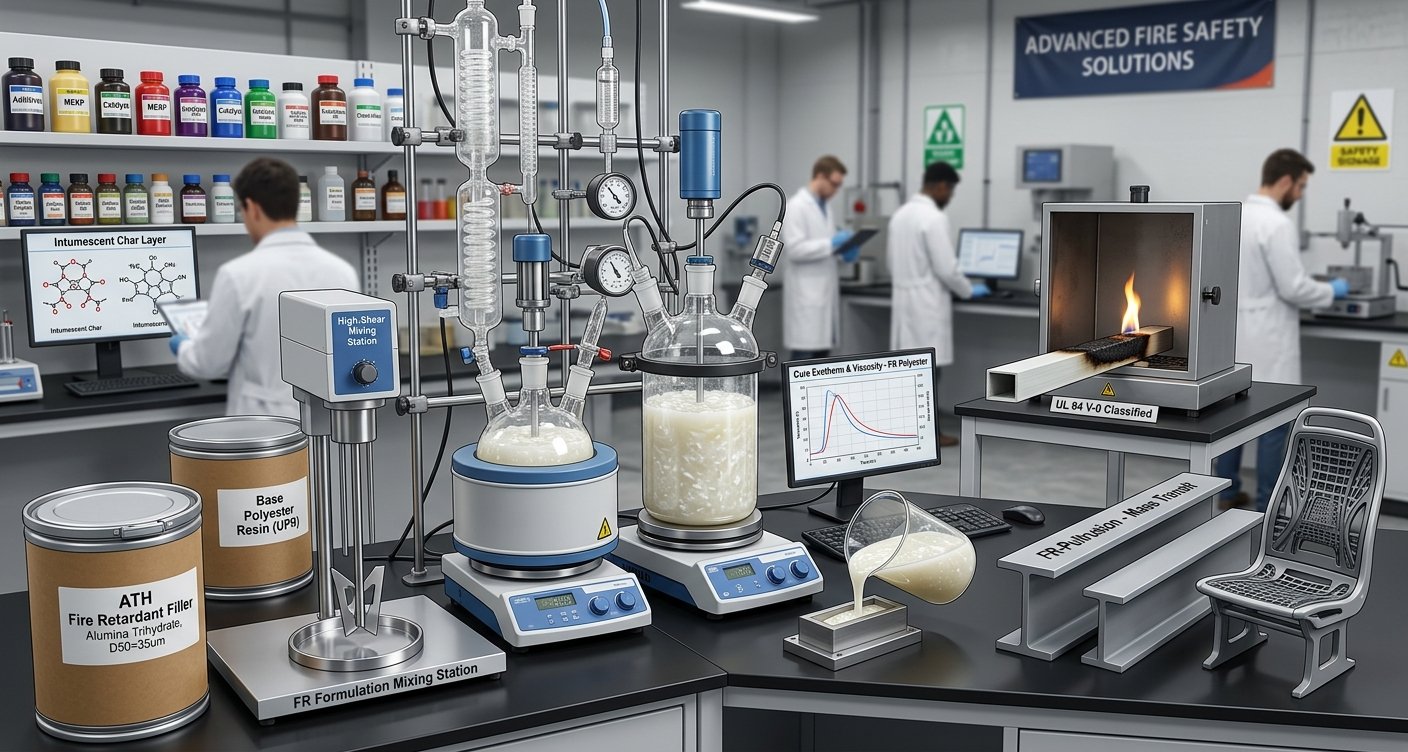
Intumescent Systems: These additives swell when exposed to heat, forming an insulating, carbonaceous char layer that shields the underlying laminate from oxygen and thermal energy.
Hydrated Fillers (Alumina Trihydrate – ATH): ATH decomposes endothermically above 200°C, releasing water vapor that cools the flame front and dilutes combustible gases.
Comparative Analysis of Fire-Retardant Resin Grades
| Resin Type | Flame Retardancy Level | Smoke Density | Mechanical Property Retention | Primary Applications |
| Halogenated Polyester | High (Class 1 / Class A) | Moderate to High | Excellent | Exterior architectural panels, industrial ducting |
| ATH-Filled Ortho/Iso | Moderate to High | Low to Moderate | Moderate (higher viscosity) | Mass transit components, structural pultrusion profiles |
| Phenolic Resins | Superior (Inherent FST) | Extremely Low | High | Aircraft interiors, underground mining, marine bulkheads |
Processing Considerations for FR Resin Formulations
Viscosity Management: High loading levels of ATH (often 40%–60% by weight) significantly increase resin viscosity. Use specialized wetting agents to maintain flowability for hand lay-up or RTM processes.
Cure Calibration: Inorganic fire retardants can absorb exotherm heat during polymerization. Precisely adjust MEKP catalyst levels and accelerators to ensure complete cross-linking.
Surface Quality: High filler loadings can affect surface smoothness. Applying a gel coat layer over the FR laminate ensures high weatherability and a clean finish.
Integrating fire-retardant resin chemistry allows composite manufacturers to comply with global safety standards while delivering light, strong, and corrosion-resistant structural products.