-
By pgigrwpakistan
-
February 8, 2024
- 3 Comment
The Backbone of Composites: Understanding Unsaturated Polyester Resin (UPR)
When you look at a boat hull, wind turbine blade, or custom fiberglass automotive panel, you are seeing the power of advanced polymer materials at work. At the heart of most modern fiber-reinforced plastics (FRP) is Unsaturated Polyester Resin (UPR)—one of the most versatile and widely used thermosetting polymers in industrial manufacturing today.
What is Unsaturated Polyester Resin?
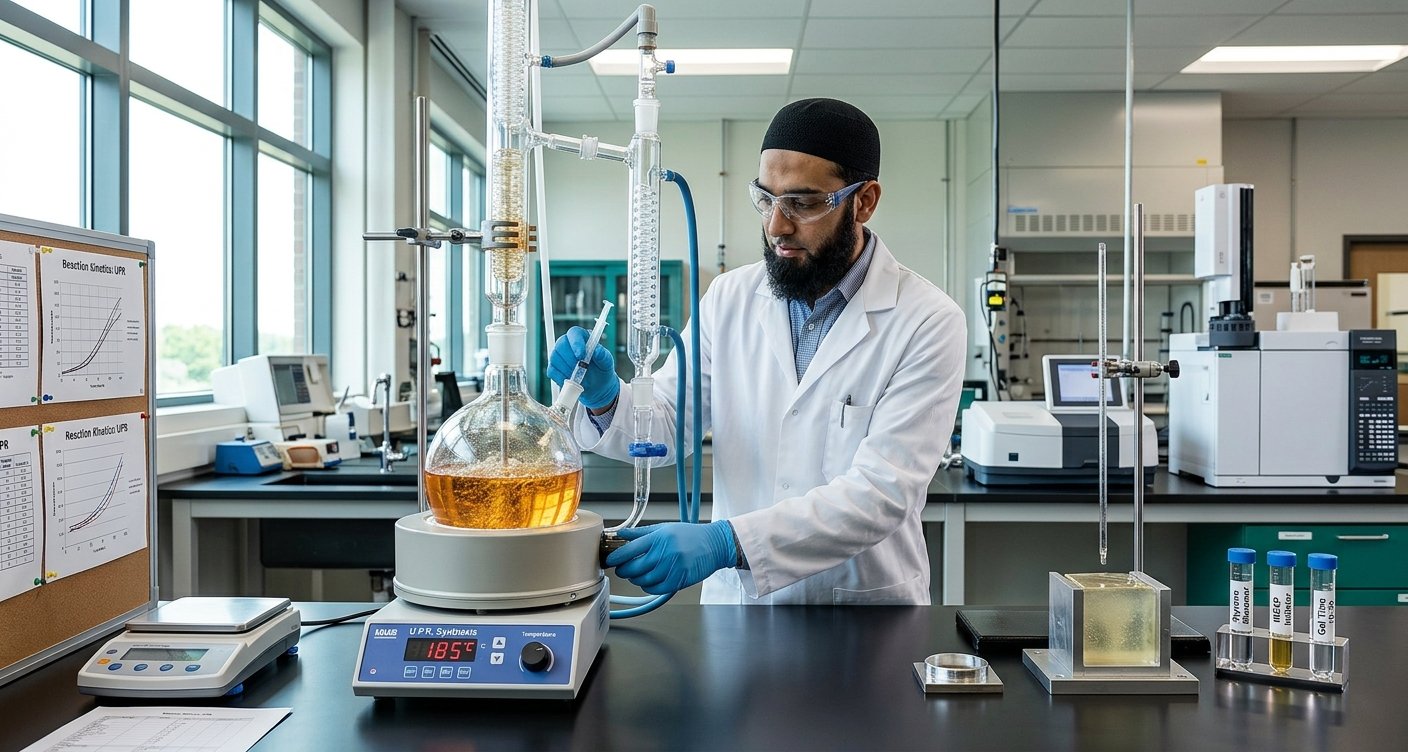
Unsaturated Polyester Resin is a liquid polymer produced by the condensation reaction between dibasic organic acids (such as maleic or phthalic anhydride) and polyhydric alcohols (like propylene glycol).
The term “unsaturated” refers to double carbon bonds ($C=C$) present along the polymer backbone. These double bonds are reactive points that allow cross-linking when mixed with a reactive monomer—most commonly styrene.
How UPR Curing Works
Unlike thermoplastics that melt and reshape under heat, UPR is a thermosetting polymer. Once cured, it forms a permanent, highly durable 3D molecular matrix that cannot be remelted.
Liquid State: The resin is supplied as a viscous liquid dissolved in styrene monomer.
Activation: A catalyst/initiator—typically Methyl Ethyl Ketone Peroxide (MEKP)—is added to initiate free-radical polymerization.
Cross-Linking: The double bonds in the polyester chain react with the styrene monomer, locking the molecules into a rigid, solid network.
Key Characteristics & Advantages
Why is UPR chosen over alternative materials like epoxy or vinyl ester for mass production?
Cost Efficiency: Significantly cheaper than epoxy resin while offering strong structural performance.
Ease of Processing: Can be processed at room temperature using open-molding methods (hand lay-up, spray-up) or closed-molding systems (RTM, pultrusion).
Chemical & Water Resistance: Highly resistant to moisture, mild acids, and weathering when formulated correctly.
High Strength-to-Weight Ratio: Combined with glass fibers, UPR creates lightweight structures with exceptional mechanical strength.
Primary Applications Across Industries
| Industry | Common Uses |
| Marine | Boat hulls, decks, gel coats, and personal watercraft. |
| Construction | Roofing sheets, marble composites, pipes, tanks, and sanitaryware. |
| Automotive | Body panels, structural reinforcements, and truck cabs. |
| Renewables | Wind turbine blades and protective casings. |
Conclusion
Unsaturated Polyester Resin remains the workhorse material of the composite industry. By combining affordability, versatility, and structural strength, UPR continues to power innovation across marine, automotive, and infrastructure sectors worldwide.
Accusamus iusto odio dignissimos ducimus blanditiis praesentium voluptatum deleniti atque corrupti quos dolores
Deleniti atque corrupti blanditiis iusto odio dignissimos ducimus blanditiis praesentium voluptatum deleniti atque corrupti quos dolores
Ducimus blanditiis iusto odio dignissimos ducimus blanditiis praesentium voluptatum deleniti atque corrupti quos dolores